


The Setting

Winston lives in Oceania, specially Air Strip One, which is the new name for England. As you can see from the map, Air Strip One is right next to hostile territory, which is why it is so easily bombed.
Time - well, 1984, however, the date is not important. It is a warning of our future. Orwell wanted to title it 1948 since it was being published in 1947, but his publishers thought a more futuristic date was needed. It could easily be titled 2020 or 2040. The revolution must have happened somewhere in the late 50s. Winston's childhood may have been free from Ingsoc, but he cannot remember anything from that far back.
Jump to sections in the book:
- Book 2
- Book 3
- Characters (side bar)
- Newspeak (side bar)
- Double Think (side bar)
- Junior Anti-Sex League (side bar)
- Propaganda Project
- Test Review

Read This Book!
Big Brother has deemed it O.K. for party members to read this book. Don't have one of those old fashioned paper kind? Never fear! You can read it here as a synthetic book (or synthbook in Newspeak): READ ME
Or you can click each chapter as linked on the left.
There is a comic book version being done by Frederick Guimont. Check out his page here:
I've had problems getting the site to work, so I provided links to the chapters completed in the chapter section. Try the official site first.
Characters
Primary Characters
- Winston Smith - our protagonist
- Juilia - that girl with the dark hair
- O'Brien - "We shall meet in the place where there is no darkness"
- Mr. Charrington - the elderly store owner
Secondary Characters
- Mr. Parsons - sweats a lot
- Mrs. Parsons - tired and worn out. They are Winston's apartment neighbors
- The Parsons kids - little brats
- Syme - Newspeak expert
- Katharine - Winston's estranged wife
- Emmanuel Goldstein - public enemy number 1 - leader of the brotherhood

Corena J. is awesome.
Newspeak
The language of Oceania. This is English, but with words removed. In fact words get removed every time they update the dictionary. The idea is that eventually there will be whole generations that have no words for ideas like freedom, so there would be no way in which to even think about that concept. Here is how it is explained in the book:
Don't you see that the whole aim of Newspeak is to narrow the range of thought? In the end we shall make thoughtcrime literally impossible, because there will be no words in which to express it. Every concept that can ever be needed will be expressed by exactly one word, with its meaning rigidly defined and all in subsidiary meanings rubbed out and forgotten.
Here is a basic primer:
Take a word (GOOD). To make the opposite, put un in front of it (UNGOOD).
To say any word that means very good (great, fantastic, wonderful, etc.)
just used the word plus or doubleplus (PLUSGOOD). Do the same to make
it more negative (DOUBLEPLUSUNGOOD).
The Appendix goes into more detail on Newspeak.

Doublethink
This is the act of believing something to be true even though you know it is false. For example, in the book, people hear one news report. The next day, they will hear a contradictory news report. They believe the new one, even though they know it cannot match up with the old report. Here is how the book addresses it:
His mind slid away into the labyrinthine world of doublethink. To know and not to know, to be conscious of complete truthfulness while telling carefully constructed lies, to hold simultaneously two opinions which cancelled out, knowing them to be contradictory and believing in both of them, to use logic against logic, to repudiate morality while laying claim to it, to believe that democracy was impossible and that the Party was the guardian of democracy, to forget whatever it was necessary to forget, then to draw it back into memory again at the moment when it was needed, and then promptly to forget it again: and above all, to apply the same process to the process itself. That was the ultimate subtlety: consciously to induce unconsciousness, and then, once again, to become unconscious of the act of hypnosis you had just performed. Even to understand the word 'doublethink' involved the use of doublethink.

Extra Credit Opportunity - Make a meme for 1984 that captures the feel of the meme and the essence of the book. Worth 2 quiz grades. An extra ten points if the meme is so good that I put it on this page. I made this one on Image Flip.

Big Brother Is Watching You Project
You will find or create a BIG BROTHER IS WATCHING YOU poster. At the right time I will give you the dates for the assignment. You will bring the poster to me for approval and get a 60 for the grade. Then you will go out and post the poster on campus somewhere to get the remaining 40 points. You will take a photo of you with the poster and send it to me. If you would like a 110 grade, then you will seek out one of the many cameras that we have here on campus and post your poster where it can be seen by the camera. Your photo will need to show me the camera and poster so I'll know to count it.
The Junior Anti-Sex League


Propaganda Project
Thought Police

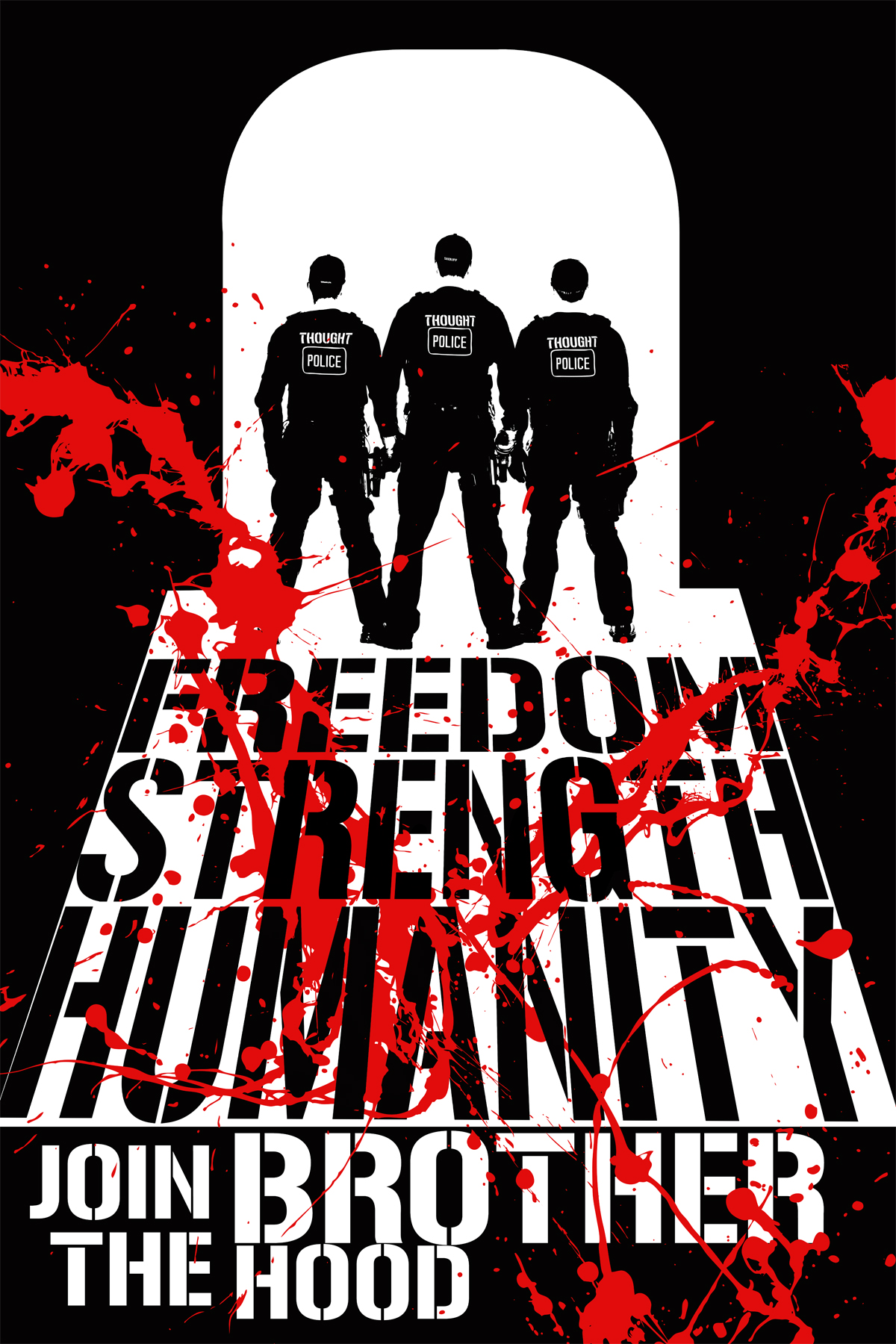
Warning! Three of your classmates secretly hold this badge and will report you if you say or even think about anything that does not promote Oceania or Big Brother. Failure to conform will mean that you may become an unperson and lose your five points bonus on the test for good citizenship.

Apple vs. Big Brother
During Superbowl XVIII in 1984, Apple used this commercial to introduce their new computer, the Apple Macintosh. It was directed by Ridley Scott.
Extra Credit Opportunity - What is grammatically wrong with this commercial? Worth 1 Daily grade.
In 2007, the commercial was re-released as an ad for Obama when he was running against Hillary Clinton in the Democratic Primary. Apparently it was not endorsed by his administration and the guy who created it resigned his position.
I Need This Shirt

A double plus good student would get it for their favorite teacher.
Why Not Watch Big Brother for a Change?
This 1956 version is, well, old. However, it does loosely follow the book.
This is a documentary about the book and George Orwell. If you are trying to understand what the book is about, watch this. It is about 45 minutes long.
This is an animated summary of the book with analysis provided by Sparknotes. You may wish to watch this before the test.
Captain Britain vs. The Thought Police

In Mighty World of Marvel, a British Marvel comic, vol.2 issue 13, "A Funeral on Otherworld", Captain Britain faces off against a 1984 world. This issue was released in none other than the year 1984, of course.
Extra Credit Opportunity: This is Earth-744. Research this or other Marvel alternate realities in the extra credit assignment Marvel Multiverse.
Manray Is Watching You

In Spongebob Squarepants, "Back to the Past" features
an 1984-ish dystopia where Manray takes ove Bikini Bottom.
Return to 12th Grade Page
Return to Lord Alford Site
Teachers! If you've enjoyed this site, you might like Extreme English Teacher Blog.
Thanks to www.gerenser.com/1984 for this list of questions. I modified a few of them to meet the needs of my class. Use these to check your understanding.
Book 1 ~~~~~~~~~~~~~~~~~~~~~~~~~~~~~~~~~~~~~~~~~~~~~~~~~~~~~~~~

Synthbook
Read
it
Read
it (alternate link)
Comic
Book Version
Audio Book
Book 1 Chapter 1

Questions:
1. What bothers Winston?
2. What is wrong with his society?
3. What are the three slogans of the Inner Party?
4. What are the four ministries?
5. What items are written in italics?
6. How does the Two Minute Hate work?
7. What happens to Winston during the chant?
8. What happens between O’Brien and Winston?
9. During the film, how did the audience react?
10. What is "thoughtcrime"?
11. What are the Thought Police?

Synthbook
Read
it
Read
it (alternate link)
Comic
Book Version
Audio
Book
Book 1 Chapter 2
The One with the Most Annoying Kids in the World

Important line:
"Thoughtcrime does not entail death, thoughtcrime IS death."
Questions:
1. Who are the Parsons and what do they represent?
2. How do the Parsons’ children behave?
3. What is Winston's dream about O’Brien?
4. What is announced on the news?

Book 1 Chapter 3

In this chapter, Winston has to do his daily exercises. While he does so, he gives us more information about what it is like to live in this world. Note that they can, and do, watch you through the telescreen. This is evident by how she tells calls on Winston to work harder on his toe touches. It also shows the power of fear. This also shows how incredibly dangerous it is for Winston to pursue the diary.
Important concepts:
Doublethink - click to go to the side bar bit that discusses this concept.
Important lines:
"'Who controls the past,' ran the party slogan, 'controls the future: who controls the present controls the past.'"
"A single flicker of the eyes could give you away."
Questions:
1. What is Winston’s dream about his mother? How does he feel about himself
in that dream?
2. What is his dream about the "Golden Country"?
3. What does he remember about the big events of the past? Bombs? Past
Wars?
4. Explain the Party slogan, "Who controls the past controls the future;
who controls the present controls the past."
5. What does he know about the legends concerning Big Brother?

Book 1 Chapter 4
Important concepts:
Proletariat - the Proles
- the masses, the uneducated, they do the most of the hard physical work
unpersons - someone who
no longer exists because the government has erased every reference to
them
BB - Big Brother
Newspeak
- the language of Oceania - click to go to the sidebar bit that discusses
it.
Important line:
"Withers, however, was already an unperson. He did not exist; he had never existed."
Questions:
1. Describe Winston’s job.
2. How is the past controlled?
3. What special literature, music, and entertainment is produced for the
proles?
4. How does Winston feel about his work? What sort of "creativity" is
involved?
5. What is the significance of Comrade Ogilvy?

Book 1 Chapter 5
Important lines:
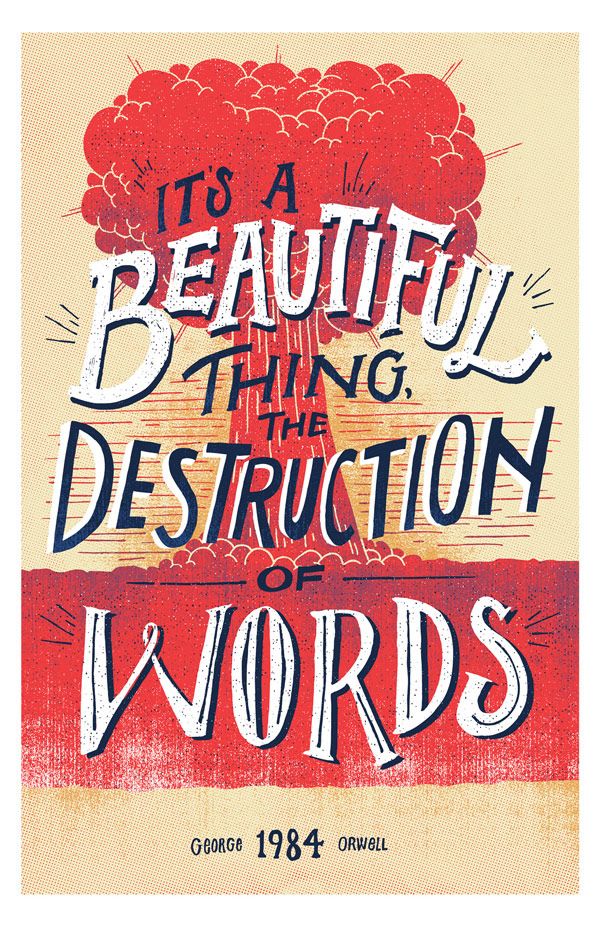
"It's a beautiful thing, the destruction of words . . . In the end the whole notion of goodness and badness will be covered by only six words — in reality, only one word. Don't you see the beauty of that, Winston?"
"Don't you see that the whole aim of Newspeak is to narrow the range of thought? In the end we shall make thoughtcrime literally impossible, because there will be no words in which to express it. "
"Orthodoxy is unconsciousness."
Questions:
1. What is the problem with obtaining razor blades?
2. What is revealed about Inner Party philosophy in the discussion between
Winston and Syme?
3. Why does Winston feel that Syme will be vaporized?
4. Parsons brags about his children for doing what?
5. What is the significance of the telescreen announcement?
6. What are Winston’s feelings about the present time after he hears the
cheerful announcement on the telescreen?
7. Winston predicts that certain people will be vaporized and that certain
people will never be vaporized. Which one of these people does he predict
will be vaporized and which ones never wil be:
- Mrs. Parsons
- Syme
- Himself
- O'Brien
- Parsons
- The guy quacking (not really) like a duck at the next table
- The little beetlelike men
- The girl with the dark hair
8. Who does Winston catch watching him?

Synthbook
Read
it
Read
it (alternate link)
Audio
Book
Book 1 Chapter 6
The X-rated Chapter

Questions:
1. What is the purpose of marriage in the state?
2 . What do Winston’s memories about visiting a prostitute reveal about
his attitudes towards sex in Oceania?

Book 1 Chapter 7

Important lines:
"Freedom is the freedom to say that two plus two make four. If that is granted, all else follows."
"If there is hope, it lies with the proles."
"Proles and animals are free."
In this chapter, it talks a lot about the past and the problem with knowing what to believe. Winston's big fear is not that he will get caught, but that he is wrong. There is no way of proving that the government is lying about history.
One thing the children's history book mentioned was that before the party, infant mortality rate was 300 per thousand while now that the party in in charge it is down to 160 per thousand. This statistic is a way to analysis the effectiveness of medical advances in countries by measuring the number of deaths of babies in their first year of life. To put this in context, the US rate in 1930 was 99. Today the US has a rate of 6. The world average is 49. The worst country in the world is Afghanistan which currently has an infant mortality rate of 135.
Questions:
1. How does Winston view the proles?
2. How are the proles controlled (prole control)?
3. What lies/half-truths does the Party teach about history?
4. Winston suspects that the Party lies about progress made since the
war. What Party claims does he doubt?
5. What is the story of Aaronson, Jones and Rutherford?
6. Why is this story so meaningful for Winston?
7. What is Winston’s unanswered question?
Book 1 Chapter 8
Important:
Symbols -
- the diary
- the paper weight
- the nursery rhyme
Questions:
1. Why does Winston go off on his own? What activities is he missing
out on?
2. What is life like in the proles’ end of London?
3. What does Winston think about after his conversation with the old man
in the pub?
4. What does Winston discover at Mr. Charrington’s shop?
5. What is Mr. Charrington like?
6. What does Winston think when he sees the dark-haired girl outside Mr.
Charrington’s shop?
7. How does one’s own body betray a person?
8. Why does Winston wonder about church bells ringing in London?
Book 2

Synthbook
Read
it
Read
it (alternate link)
Audio Book
Book 2 Chapter 1

Questions:
1. What part of her body has the girl with the dark hair injured?
2. How does Winston react to the note from Julia before he reads it?
3. What does the note say?
4. How does Winston react to the note after he reads it?
5. Where do they manage to meet for a few seconds?
6. When they meet again, who are the prisoners in the first trucks that
go by?
7. What does Winston notice about the prisoners in the last trucks that
go by?
8. What physical act does Julia do to Winston before she leaves?

Book 2 Chapter 2

Questions:
1. Why is Winston ill at ease once he is alone with Julia?
2. What does Julia bring with her that she has obtained on the black market?
3. What does Julia do that she says is the only way to stay safe?
4. What seems familiar to Winston?
5. What does Winston mean when he says that he loves Julia all the more
because she has had scores of sexual encounters?

Synthbook
Read
it
Read
it (alternate link)
Audio Book
Book 2 Chapter 3
Questions:
1. How and where do Julia and Winston meet?
2. What is Julia’s job?
3. What is her background?
4. What is her attitude toward the Inner Party?
5. Describe Winston’s marriage.
6. What do Winston and Julia disagree about?

Synthbook
Read
it
Read
it (alternate link)
Audio
Book
Book 2 Chapter 4

"He was standing in front of a wall of darkness and on the other side of it there was something unendurable, something too dreadful to be faced. In the dream his deepest feeling was always one of self-deception, because he did in fact know what was behind the wall of darkness."
Questions:
1. How does Winston react to the singing prole woman?
2. What is Winston’s reaction to rats? Julia’s reaction?
3. Winston is interested in the church bells that once played in the city
even though he is not religious. What do church bells mean to him?
4. Winston sees the coral paper weight as a symbol of what?

Book 2 Chapter 5

"Both of them knew - in a way, it was never out of their minds - that what was now happening could not last long."
"He told her of the strange intimacy that existed, or seemed to exist, between himself and O'Brien, and of the impulse he sometimes felt simply to walk into O'Brien's presence, announce that he was the enemy of the Party, and demand help. Curiously enough this did not strike her as an impossibly rash thing to do."
Possible futures that Winston envisions:
- Their luck will hold out indefinitely
- Katharine would die, and Julia and Winston get married
- They commit suicide together
- They disguise themselves and live in secret among the Proles
- They engage in active rebellion against the Party
- They get caught
Questions:
1. Who has vanished?
2. Describe the preparations for Hate Week. In what ways does the Inner
Party excel in building spirit?
3. Julia and Winston have some differences. Explain them.

Book 2 Chapter 6
Questions:
1. What finally convinces Winston that O’Brien is a member of the Brotherhood?

Book 2 Chapter 7
Questions:
1. What does Winston remember about his family and his relationship with
his mother?
2. What does Winston realize about love and loyalty as a result of his
dream?
3. What is the difference between confession and betrayal?

Book 2 Chapter 8
Questions:
1. What can O'Brien do that others cannot?
2. Is Winston prepared to throw acid in the face of a little child?
3. What is the one thing Julia and Winston are NOT prepared to do?
4 . What information does O’Brien give them about the Brotherhood?
5. How will O’Brien get The Book to Winston?
6. Where does O'Brien say that they shall meet again?

Book 2 Chapter 9

Read the summary.
Questions:
1. Oceania is and always has been at war with _________.
2. What does the speaker have to do in the middle of his speech?
3. According to the manifesto, is there really a war with other countries
going on?
4. What is a central tool of the ruling party?
5. What does Julia do while he reads the book?
Book 2 Chapter 10
Questions:
1. What is behind the picture of the church?
2. What is the significance of the glass paperweight here?
3. Who betrays Winston?
Book
3

Book 3 Chapter 1
Questions:
1. Where is Winston? How is he treated there and why?
2. Why is Ampleforth here?
3. Who turned in Parsons?
4. What happens between the starving man and the chinless man?
5. What effect to the words "Room 101" have on the skull-faced man?
6. Why is O'Brien here?

Book 3 Chapter 2

Important lines:
"'What is in Room 101?' The expression on O'Brien's face did not change. He answered drily. 'You know what is in Room 101, Winston. Everyone knows what is in Room 101.'"
Questions:
1. What is the photograph of that gets Winston so uptight?
2. Why is Winston still punished when he says O'Brien is holding up 5
fingers?
3. Why does O'Brien say that Winston has been brought here?
4. What part of Winston will remain for posterity?
5. What does O'Brien tell Winston about Julia?
6. What does O'Brien say is in room 101?

Book 3 Chapter 3

Read the summary.
Important lines:
"If you want a picture of the future, imagine a book tamping on a human face - forever."
"I have not betrayed Julia," he said. O'Brien looked down at him thoughtfully. "No," he said, "no; that is perfectly true. You have not betrayed Julia."
“Tell me,” he said, “how
soon will they shoot me?”
“It might be a long time,” said O’Brien. “You
are a difficult case. But don’t give up hope. Everything is cured
sooner or later. In the end we shall shoot you.”
Questions:
1. According to O’Brien, what are the three stages in Winston’s re-integration,
and which stage is he about to enter?
2. Who wrote Goldstein’s book? Is what the book says true?
3. Why does Winston feel he is morally superior to O’Brien and how does
O’Brien prove that Winston is wrong?
4. What good thing can Winston say about himself at the end of this chapter?
5. How does Winston feel about O’Brien? Why?
6. What final question does Winston ask O’Brien?

Book 3 Chapter 4
Read the summary.
Questions:
1. How has Winston’s environment changed? What does he do with his time?
How does he show his obedience to the Inner Party?
2. How does Winston show that he is not entirely true to Big Brother?
3. How does Winston feel about Big Brother?

Book 3 Chapter 5

Questions:
1. What happens in Room 101 and how does this "cure" Winston?

Book 3 Chapter 6
Questions:
1. What is the setting?
2. What is Winston’s job? (Look up "sinecure" if you don’t know it)
3. How did his meeting with Julia go?
4. How is it evident that Winston really is a different person?
5. What is happening in the last two paragraphs of the book?

Test Review
See how well you do on this Spark Notes book quiz. It has similar questions to the book. Go back and look through this web page at all the important quotes listed for each chapter as well.