-----------------
__________

2012 Due Dates
Meet these deadlines and get an easy 100 every time!
3/22 - blank note cards (50) (weighted
once)
3/23 - 10 completed note cards (weighted once) (but
you really want to have 20)
3/27 - 25 completed note cards (weighted 1.5) (but
you really want to have 30)
3/29 - 40 completed note cards (weighted 1.5) (but
you really want to have 50)
4/10 - Bring your note cards and source cards to class
(weighted once)
4/12 - Bring in 1 typed* page (weighted twice)
4/18 - Bring in 2 typed* pages (weighted twice)
4/20 - Bring in works cited page (weighted twice)
If you meet these deadlines, that is the equivalent of 12 daily
grades!
* If you must turn in a hand written rough draft on peer edit days,
then 3 hand-written single spaced pages (one side) counts as one typed
page.
4/24 Tuesday -
CAREER PAPER DUE (it doesn't matter if you are present or absent, it
is due this day)
What are you researching?
This paper is research a career,any careerany legal career, that you may wish to pursue after high school.
What do you need?
-
A career choice
- note cards (about 50)
- the MLA Bliss sheet
- plagiarism sheet
- in text sheet
- any contacts you want
- any materials you can find at home, on the internet, at school, or mail off to get - you will need to have at least 4 different sources cited in your paper
- time to type this on the computer
I need a career choice!
Talk to your parents and/or try F4K. Here's how -
- Go this web site
- Your username is NC-student number
- Your password is your birth date with no slashes or extra zeros or whatever you changed it to (I can look that up for you)
- Click the purple ASSESSMENT tab.
- Click the CAREER MATCHMAKER tab.
- You will answer 39 questions and then it will generate a list of possible career matches.
What should you look for when researching?
-
Job description
- Education and training needed
- Salary and benefits
- Working conditions and reality of the job
When you research, you could try to answer these questions if you need help figuring out what to research:
1. What is the average starting salary?
2. What is the average salary?
3. Why does this job fit me?
4. What type of education do I need?
5. Which schools (if needed) would be good schools to get my degree in for this career?
6. Do I know anyone in this career? If so, I should ask them some questions.
7. What does this career do?
8. What levels are there in this career?
9. What are some dangers with this career?
10. What about this career will be difficult for me?
11. What do I need to be doing to get this career?
12. What is average retirement age for this career?
13. What benefits are associated with this career?
14. What sort of grades do I need to have to get this career?
15. What courses would be useful for me to take in high school to get this career?
16. Would I need to move to have this career?
17. Does this career require traveling?
18. What are the chances of me getting this career?
And any others that you can think of!
O.K., I Have My Cards, Now What?
Well, the first thing you want to do is separate your cards into source cards and note cards.
Check your source cards:
-
Do you have four sources? If not you need to get more.
-
Does each source card have a different source code on it? If not, you need to make one and then make sure the note cards you got out of that source has that same source code.
-
Does each MLA end with a period? If not, put one there. Every MLA has a period at the end.
Check your note cards:
- Does every note card have a source code on it? If not, figure out which source it came from and put the code there.
- Do cards from book, newspaper, and magazine sources have page numbers on them? If not, you have the fun task of figuring out which page it came from and putting it there.
- Does every card have only one piece of information on it? If not, you should go back and put the extra information on extra cards. Don't forget to source code and page number them.
Now, write your thesis statement.
Now what?
- Take your index cards and remove the source cards. Then take out all the cards that deal with the education and training needed. Write EDU on the top left corner of all of these cards. Set them aside. With the remaining cards, do the same thing for all cards dealing with salary and benefits. Mark these with a $. For the others, remove all cards that describe the job. Write JD on the top left corner. With the cards that are left, remove all that deal with the working conditions and write REALITY on the corner. The cards that are left will be marked MISC.
- Do you need more cards in any stack? If so, go back to researching. Now would be a good time to get a personal interview.
- Pick up the stack of cards marked JD. Put these cards in order of how you think the information should be presented. Lay these cards face down. Do the same thing for the EDU cards. Place these cards face down on top of the JD stack. Do the same thing for the $ cards, then for the REALITY cards. You do NOT do this for the MISC cards. You will probably not use these cards. Now your cards are in order for writing your paper.
- Time to write. Skip the introduction of your paper. Start with the first paragraph of the body of your paper. This is the job description section. The first note card in your stack is the first piece of information you'll use. After you use that piece of information, put an in-text. Put that note card to the side and work in the second note card, again using in-text afterward. Keep doing this until you run out of job description cards.
- Hit enter and then tab to start a new paragraph. Repeat the above but use the EDU cards. Do it again for the $ cards, and again for the REALITY cards.
- Now write a paragraph or two that tells why this is a good career choice for you (if you have decided that you no longer like this job, tell why it is NOT a good career for you).
- Look over your paper. Are any paragraphs too long? Break it into two paragraphs.
- Write your introduction paragraph at the top of your paper.
- Write your conclusion paragraph at the bottom of your paper.
- Clean up your in-text.
- Do you have at least 2 FULL pages? If not do some more research and add it in. Do you have more than 3 pages? Go back and remove some information.
- Write your works cited page.
When you turn in your paper, you should turn it in inside of a manila envelope. Here is what you should have:
1. Note cards – whether you used them or not
2. Source cards – same as above
3. Rough draft(s) – needs to show some corrections – just do not print your final copy twice
4. Plagiarism sheet – signed by you and a parent or guardian
5. A red pen – not really needed, but if you give me one, I’ll give you a bonus of up to 5 points, depending on how nice of a pen it is
6. Your Rubric – This is the sheet I will use to grade your paper with
7. Final copy – duh!
How should my final copy be presented?
• Title page – has your name, period, and the title of your paper - this is not counted as the 2 to 3 pages of your paper.
• Body – this is the 2 to 3 pages of your paper.
• Works Cited – this is not counted as the 2 to 3 pages of your paper. It is last and has all of the sources that are used in your paper.
Staple all of these once in the upper right hand corner of the
page – no folders! no fancy clear plastic binders!
Handouts
- MLA Bliss Sheet
- In-Text / Parenthetical Documentation
- Note Cards / Source Cards
- Plagiarism for Dummies
- Thesis Statement
- Works Cited Page
- Greenstreet Outline Special

How Many Note Cards Do I Need?
Well, it takes, on average, 10 note cards to write a page of paper. So I say you need at the bare minimum 30 cards. I would feel better if I were writing the paper and I had 40 - 45 cards. This way if some of the cards are duplicate information or just does not really fit into my paper, I have plenty of others to fall back on.
I'm Researching On My Own! Where Do I Go?
There are several things you can do:
- Our school library - it is open before school, during lunch, and after school. You can find what books we do have before you go and save some time by going to our web based card catalogue.
- Try the internet - Try
these good sites:
- Occupational Outlook Handbook Online - same great information as in the book form, but more up to date. You can use both the book and the site as two separate sources.
- Orange High School Web Path Express - better than Google since it weeds out the unwanted web sites and just gives you the stuff good for research.
- Princeton Review Career Search - you name it, they have it and plenty of information to get several note cards to boot!
- NCWise Owl - I can give you the password if you need it. Go to High School, then choose Careers.
- Future for Kids - It's the same site that we used to register for classes and do that survey in class on career choices. they have information about each career there too.
- Try the public library - it's near Banditos. After researching, grab a Burrito! Don't want to waste your time going to the library only to discover that they don't have the book you wanted? You can search online at search online.
- Ask someone - especially if you know someone in the field. Treat it as a personal interview for your source card.
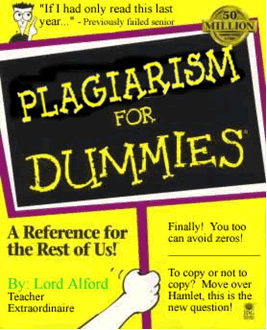
A signed plagiarism sheet is required for the paper.
Want an example to go by? Try Chad's paper on working in a recording studio. Some of the expectations of the paper have changed since this one was written; however, it remains a good example of the kind of thing we are looking for. Will your paper be good enough to be included as an example for next year?
Paper Rater

Follow these directions to get your paper reviewed automatically. It is not perfect (in fact, it is far from perfect), but it is a good start.
1. First, complete your paper.
2. Next, highlight your paper (not your works cited, title page, title, or name) and hit CTRL-C to copy the text.
3. Minimize your paper.
4. Open your Internet browser. Then go to http://www.paperrater.com/free_paper_grader.
5. Write your title in the title box. If you don’t have one, just make one up.
6. Click in the large text box and hit CTRL-V to paste your paper into the box.
7. Minimize the Internet browser.
8. Pull up your paper again and this time copy your works cited information.
9. Minimize your paper and pull up the Internet.
10. Paste your works cited information into the bottom text box.
11. Choose 11th grade for the education level of the author. Trust me.
12. Choose Research Paper as the type of paper you are submitting.
13. Click the large Get Report button.
14. Wait.
15. Once the next page pops up, you will see your paper with some words highlighted in green, red, blue, etc. You can click on these for suggestions. On the right hand side of the screen you can click for specific information. There is Plagiarism Detection, Spelling, Grammar, Word Choice, Style (style is like the next level of grammar), Vocabulary Words, and Grade (it will actually grade your paper, but only if you put 11th grade or higher as your education level).